
Why minimum service levels beat first-come-first-served
Ask any practice manager how leave is allocated and you'll usually hear some version of "first come, first served". It sounds fair. It's simple to explain. And every August it quietly falls apart.
The problem with the queue
First-come-first-served optimises for one thing: who asked earliest. It says nothing about whether the practice can actually function on the day. In practice it produces three predictable failures:
- The land grab. The moment next year's calendar opens, the organised few book the school holidays solid. Everyone else learns to ask earlier next year — not to plan better, just to ask earlier.
- The accidental breach. Each request looked fine when it was approved. Three approvals later, Thursday afternoon has no prescriber. Nobody did anything wrong; the queue just doesn't see the whole picture.
- The guilty no. When an approver finally refuses a request, they can rarely point to a rule. It becomes personal — "you said no to me" — and resentment compounds.
Start from the service, not the queue
There's a better question than "who asked first?" — it's "what does the service need?" That's a number you can write down: two pharmacists every session, one prescriber every morning, three receptionists on Mondays. We call these minimum service levels, or MSLs.
Once MSLs are explicit, leave decisions stop being judgement calls:
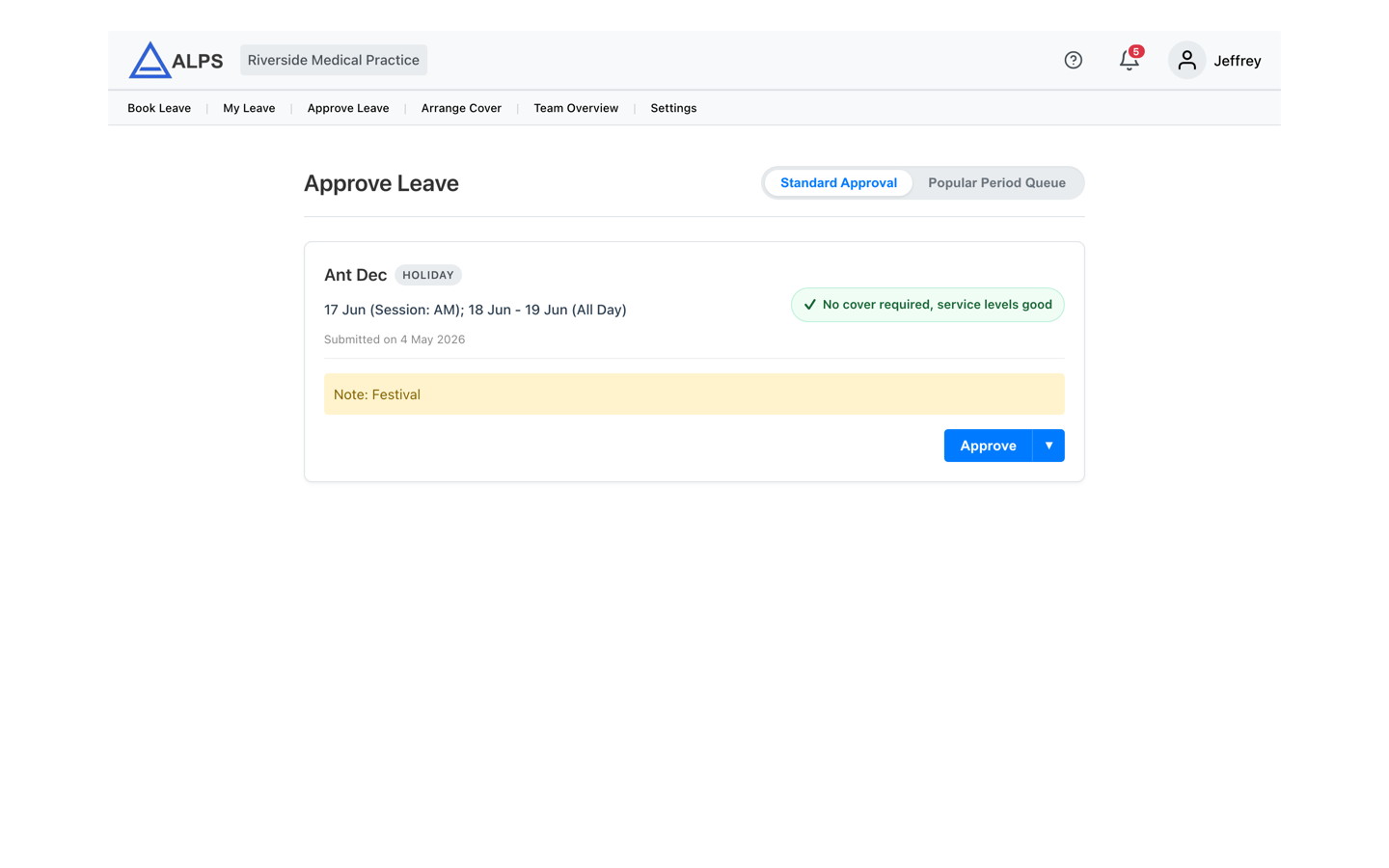
A request that keeps every session at or above its minimum can simply be approved. A request that doesn't is a cover problem to solve — not a person to refuse.
That reframing matters. The conversation shifts from "I'm saying no to you" to "Friday morning needs a locum before this can be a yes". It's objective, it's visible, and it's the same rule for everyone — including the people who never learned to play the booking game.
What about genuinely contested weeks?
MSLs answer "can the practice cope?", but some weeks more people want off than any rota can allow. For those, transparency is the fairest tool you have. ALPS flags popular periods up front — staff can see demand is high before they book, and contested requests go through a dedicated queue where they're decided together rather than picked off one by one.
The payoff
Practices that switch to service-level-driven approvals tend to notice the same things: decisions get faster (most requests are an instant, defensible yes), cover gets arranged earlier, and the annual leave arms race cools down because the rules are finally the same for everyone.
ALPS builds this whole approach in — MSLs per role, automatic recommendations on every request, breach detection and a locum cover workflow for the gaps. If you'd like to see it on your own rota, get in touch or get started for £69 a year.
— The ALPS Team